I’ve waited 19 years for THIS: We Are Beginning to Talk About THE CURE. It’s HAPPENING!
Stay with me on this, because the way this came to my attention was…full of synchronicity.
I was talking to someone from UCSF to plan my next trip there, hung up, and this was published. It came to me about 4 hours later. Talk about a God wink…
But on that call, the discussion had changed. We talked about the cure, treatments, strategy, new information, and different tests than before…
These were things we weren’t talking about 12 years ago, that’s for sure.
I started this blog 11 years ago (after the original one I started in 2005). I felt then like I had to kick and scream and fight for this day to come. I also felt it would never arrive. I did have hope. I just didn’t want to kid myself that I would ever live to see this day.
And here it is. Onward. 🫡
There’s so much to say after what I’ve witnessed over the past 20 years since my mom became ill and I just don’t know where to begin.
The past nine days since this story came out have been a watershed moment in my life. I truly lived the past two decades as though I were going to die of this too, just to put things in proper perspective. It’s the framework from which I made choices and decisions. I regret none of those.
This does change life going forward. For all of us. The best part?
Most of the world doesn’t even know or realize it. I always hoped it would be exactly this way. 😊
The article from Science talks about the heroes of this field, the possible treatments, and quotes the heavy hitters. The notable takeaways are sprinkled throughout. It’s no exaggeration to say that I sobbed through reading it and needed the past 9 days since to process what this means for me, you, and the world.
The fact that a cure for prion disease may also eliminate Alzheimer’s and ALS was always possible and probable. It was always discussed. But to be one step closer… I am humbled.
There were times over the years that I consciously chose to walk away, to not dive too deep. I’ve never been to a family conference, for example.
I chose not to make this my life—a decision I also don’t regret.
Some did choose to devote their lives to this, and I have nothing but respect for them as they are saving all our lives. I will die on my hill about how prion disease is not rare. I do not support the CJD Foundation; I only support the CURE. (Please donate to the UCSF Memory & Aging Center or Prion Alliance if you donate).
I want you to put your money toward the CURE, not anything else.
Lives have always been on the line and far too many have suffered. We don’t need to raise awareness and all that treading water kind of stuff. Let’s finish this. The cure for CJD will lead to other cures. This is what’s important.
Let’s do the maximum amount of good now that we’re on the right track.
I will return to UCSF and take notes. I am also looking forward to the rest of my life.
Ionis slates clinical trial for late 2022

I’ve waited 16 years for this!
Given the pandemic, I’ve wondered if research would be affected but it keeps trucking along. Ionis put out a press release yesterday saying it’s scrapping the plans to do a clinical trial this year in favor of looking at a different drug for a clinical trial late next year.
I’ve waited 16 years to see someone do a clinical trial. To see one in the works is good medicine for those of us who have lost loved ones to CJD — especially those of us what have lost several.
In total kismet, the news came on the anniversary of the day my great-grandfather arrived in the U.S. I am still trying to figure out if it was him or his wife who carried the mutation. Hopefully the pandemic can calm down so I can continue researching. There’s only so much I can do online.
I hope Ionis finds success with their clinical trial next year. Even if they don’t, it’s time to make progress on finding treatment for CJD — a disease that has yet to have its own clinical diagnosis.
Interesting study could lead to some treatments
NIH researchers are *this much* closer to being able to research drugs to treat CJD. Read about it here.
I would absolutely volunteer to be tested for any experimental drugs. Let’s change the course of history; let’s find cures for diseases. Especially the scary ones, like CJD.
Have you ever heard of a cerebral organoid before? Neither have I. Isn’t science cool?
If you’re new to the world of CJD, this is a great article that describes some of the barriers to research. Enjoy.
It’s Rare Disease Day — Which Is Problematic
It’s February 28, 2021 — 2/28 annually is “Rare Disease Day,” a day when people flood social media with graphics and hashtags like #RareDiseaseDay. I know of people who have truly rare diseases like a necrotic bone disease or epidermolysis bullosa. I know many, many more people through 16 years of online support groups who have seen a case of CJD in a loved one.
I both like and don’t like seeing awareness of CJD raised on this day every year.
There’s a caveat for many of us who aren’t feeling seen and heard on this day — those with familial mutations of CJD.
Yes, for those of you who lost someone to iatrogenic or sporadic CJD, it is a rare disease FOR YOU.
But for those of us who have lost multiple family members to CJD because our families carry one of the many genetic mutations of CJD, of fCJD, this day is a double-edged sword. Yes, awareness is (kinda) good (read to the end). But being force-fed “awareness” by calling CJD “rare” is bad.
CJD is NOT RARE.

There are three reasons for this, one I already mentioned, is that there’s no way something is “rare” when it happens over and over to a family.
The rest of my explanation as to why CJD isn’t rare is for you non-familial folks, more specifically, the sporadic cases. You can’t call something “rare” if you aren’t collecting enough data points. This has been a problem for the past 16 years I’ve been involved with this and it needs to change.
The first aspect to this three-fold problem is there isn’t an autopsy done on every single death by suspected CJD; CJD is only diagnosable to this day upon autopsy. (Unless something changed? Did I miss it? Did we manage to discover a clinical diagnosis yet?)
The second problem is, here in the U.S. at this time and for the past 16+ years, not every cow meant for human consumption has been tested for BSE.
And third, not every hunter opts to test their wild game for Chronic Wasting Disease (CWD) — as they should to ensure their safety — either.
So let’s recap:
When it comes to CJD autopsy, testing of cows for BSE, and testing of wild game for CWD — there isn’t enough autopsies or tests for prion disease being done to collect proper data in order to be able to call any and all prion disease “rare.” We have long suspected that if we did collect all this data, it may not be “rare” at all. (But your beef still will be — rimshot! Yes, there is still humor in prion world, or more accurately, my very bad jokes and sarcasm).
I’ve been doing this long enough that I don’t have hope that there ever will be proper testing done (in the U.S.) in order to collect data points. It should happen. It needs to happen. But I may not live to see it happen. Whether we are buying cow at the store or eating wild game we caught in the wilderness, we should be testing it. We aren’t testing because of cost and time. Families don’t obtain autopsies for a variety of personal reasons. Hunters just want to eat; they don’t want to wait on test results. (This is a very deadly risk to take but people take it because either they are hungry and have to eat or there’s just a disconnect about the seriousness of prion disease due to long incubation periods).
In lieu of having collected proper data, therefore, we cannot call prion disease rare. It’s NOT, nor has it ever been a “one in a million” disease. I know that sounds easy, convenient, accessible, and catchy. People love to be special, we love exceptionalism. We want to be considered rare and unique. But it’s just not true when it comes to CJD. If it were true, then I’d have at least 3,000,000 family members. (To date, I know of three who have died; I am still doing genealogical research to find more, so this may change).
CJD took my mother and uncle — each at age 56. It took their uncle at age 69. So do NOT ever try and tell me this is a “rare” disease. While I can support anything that raises CJD awareness, I choose not to do so without writing a blog post like this to make people think. It may be “rare” for some and that’s their lived experience.
But my lived experience is that CJD is NOT rare; it is generational. It doesn’t skip any generations. It is terrifying to look around a holiday table and wonder which of us will get CJD and which won’t. My Great Uncle Walter (whom I never met) was one of 14 children. My Grandfather Bernard — Walter’s brother — did not die of CJD but passed the mutation down to 2/3 of his children for certain so far (I am not sure if the third one has passed or not).
My lived experience tells me most doctors are aware of CJD from medical school and CMEs, but they have not all witnessed or treated it. I have given a speech on CJD to doctors at Barrow Neurological Institute to help them with CME credit on prion diseases in a partnership with the CDC. (They gave me a whole five minutes to speak after the CDC doctor spoke! I focused on the importance of autopsy in my speech). That may be all some experience in regards to prion disease.
My lived experience tells me many people who have donated blood or work in that field are aware of CJD as it’s part of the blood donation questionnaire. But they may never see someone suffer through it like I have.
This all brings me mixed feelings about today, “Rare Disease Day.”
I want people to care. I just want them to care in the right way.
We have a CJD Awareness Day on November 12, but a lot of CJD families hop on “Rare Disease Day” to promote awareness of CJD. We do many things to promote awareness, such as wearing shirts we make, or like I have done with this blog and my first CJD blog.
I’ve been doing this for 16 years; I no longer care about awareness.
I CARE ABOUT A CURE. I care about a clinical diagnosis. I care about research, drug trials, and a TREATMENT. I care about donating my body to UCSF when I’m dead. (This is good for science no matter what kills me and COVID-19 sure tried).
To truly obtain these things, yes, we do need “awareness.” But we aren’t going to get it without spreading the truth — and true horrors of this disease.
I want you to know about CJD. But there’s so much more I want you to know than just that it exists.
I want you to know it’s horrific and steals abilities from a person, dehumanizing them to the point they can no longer walk, speak, swallow, or know when they need to go to the bathroom — that’s just for starters. I want you to know that it quickly takes my family members in a matter of weeks — which IS RARE in the world of CJD.
Most families suffer losing a loved one for more than a year or 18 months. Imagine being a caregiver that long. Imagine watching your loved one suffer like they are trapped in their own declining body that long. They can’t speak to you about it; their brain is literally shrinking and filling with holes.
I want you to know that, while it is genetic in my family, prion diseases are also highly infectious. The bulk of prion disease has gotten around the planet because it’s highly infectious. But it also has spontaneously appeared on the planet, as it did more than 200 years ago in New Guinea. I want you to know that prion disease has been on the planet for that long and yet we still know so little about how to treat, diagnose, or cure this horrific disease. We still don’t know why proteins misfold.
I want to make you know and care about it to the point that you join me in doing something about it. I’ve been trying for 16 years.
I will close by saying something vital for all to understand.
Those of you who deal with sporadic and iatrogenic cases, you are blessed to only have to deal with it once — you only lose ONE.
For me, “raising awareness” isn’t a hobby or a trend; it’s life and death. It’s mission critical in my life to help find a clinical diagnosis, treatments, and a cure for CJD. Because there’s a 50/50 chance I die of this in less than 20 years. Getting likes on Facebook for sharing a “rare disease day” graphic is cute and all, but this is my life. There’s a 50/50 chance my generation of my family watches one another die of this in fewer years than I’d like to admit. I am trying to leave some hope for the next generation after mine.
Journals from 2004 — Part 2
A tad more backstory…
At this point in time I was going through this blind as was most of the family and my mom’s doctors. I can’t emphasize enough that none of the doctors treating my mother at this point in October of 2004 had ever seen a case of CJD before. One family member was aware of my mom’s uncle’s death by “mad cow disease” — a misnomer — and our only reference point. But that person hadn’t come forward with the information yet. I also need to emphasize that my family of origin was quite dysfunctional, self included. I have always had a “do no harm but take no shit” personality, but it came roaring out at this point in time. I should also add that I am an only child and had no siblings to “share the burden” with in 2004.

Tuesday, October 5, 2004
I don’t know much more at this point. But it seems pretty certain my mom has multiple sclerosis (M.S.). I do know for sure that I’m not ready to take care of another person — period. Especially not an elderly parent. I’m working 46 hours a week plus college.
2020 Edit:
I go into detail here about working as managing editor at the college paper, trying to balance education, an internship, and work…I was spread thin but prioritized exercise and nutrition, so I did have some aspect of self-care happening. But I was terrified at having to fit “nurse” into the picture, an eventuality that actually didn’t happen. I was committed to my own success and didn’t want to be derailed from breaking the family cycle of poverty and dysfunction. I also lamented that I didn’t have much to give my struggling parents monetarily and didn’t have cooking skills to offer either. I was trying to figure out how to take care of myself and others — but coming up short. I specifically wrote, “I am not a better person than this.” I don’t want to include too much that isn’t specific to CJD, but I think it’s important to show how the experience turns lives upside down. It’s critical to show how family members are thrown into uncharted territory and caregiver roles, forced to make important decisions with little warning… But we’ll get into that later…
Sunday, October 10, 2004
My mom has been in the hospital since Friday night. Doctors are trying to find out what’s wrong with her, but they seem almost certain it’s multiple sclerosis. I’m calm. I’ve done this hospital thing recently with my best friend. (A cancer survivor).
My poor mom. She’s so tired, so weak. The shakes… She has no motor skills. She’s not allowed to get out of bed. (She was a fall risk). She doesn’t follow what’s going on. She doesn’t remember things so well. It’s so sad to watch and so strange.
2020 Edit:
I want to tell you about the night she went to the hospital. It was October 8, 2004. While I felt relieved someone had finally gotten her to the ER, it had been a very long day. I was getting up at 2:00 a.m. for work back then (an East Coast morning drive news wire shift). I would take a midday nap, hit the books, and then Arabic class — yes, on a Friday night.
But on that day, the midday nap didn’t happen. It was the last day I saw my mother in her home. She was unable to walk and carried a plastic bag around with her as she complained of nausea and dizziness. We were long past the E200K hallmark of persistent dry cough at this point. I estimate that cough lasted several weeks or maybe two months and I truly don’t believe that she was even aware she was coughing.
Back to 10/8/04… My mother had called me frantic at work that morning and asked me to take her to her doctor for an appointment at noon. So I did. We got there and they informed us her appoint was at noon — NEXT Friday. In that moment, I realized how much my mother had lost it. She didn’t know what day it was. She was off by a whole week. So they wouldn’t see her and I took her home.
I did try to lay down and snooze, but the phone rang and it was my mother’s doctor. They were concerned she was going to try and harm herself or take her own life; they had received a strange phone call from her that had led them to believe she was experiencing suicidal ideation (S.I.).
I had no idea when she had managed to make that phone call. Since they were so concerned, and since my mother had never had shown signs of S.I. in her life, they said they could fit her in and asked me to bring her right back to the office for the MRI she had wanted so badly.
By then, I was weirded out. She could hardly walk safely and I somehow managed to get her in and out of the MRI place. Our roles had flipped. I took her back home and she was anxious and angry. I don’t remember what she was going on about, but I do remember she was talking about it in circles and getting angrier with each telling of it. Between that and getting her appointment day wrong, I was beginning to wonder if we were dealing with Alzheimer’s Disease.
When I say she couldn’t walk, I didn’t know at the time how to describe her jerky muscle movements. I know now what I was witnessing was cerebellar ataxia. I also understand now that this was due to the fact that prions (misfolding proteins) were attacking her cerebellum. I was also witnessing myclonus — the wild jerking of her legs as she tried to walk is something I will never forget.
I couldn’t witness anyone having a seizure for years — whether in real life or in the movies. I had a full-blown panic attack watching the film “Hilary & Jackie,” in which a main character has M.S.
I eventually got past this and worked in a detox and sobering unit where I safely helped many clients through their detox-induced seizures. Witnessing CJD in my mom primed me to observe suffering without freaking out. These are skills you can’t teach and this did help me save some lives. I think this is worth mentioning because not everything is without purpose. Yes, it all may be horrendous. I get that. But the suffering wasn’t wasted.
My journal from 2004 — when my mother died of CJD
Some back story first:
My mother was the first person I knew of to die of CJD in my family. Once she became sick and we started having conversations, we realized we had lost a family member to “mad cow disease” around 2001. That would have been my mother’s uncle, Walter Zadzielka. I asked for an autopsy to be done on my mother (another story unto itself) and found out my mother died of the E200K mutation. This means, if you’re in the Zadzielka family from Cleveland, this is our genetic mutation, marked by a quick onset with a persistent dry cough. From the time we brought my mother to the hospital, a mere 32 days passed. This is not what most families experience; most experience a far longer period of suffering.

I am choosing to do something I’ve always wanted to do, which is share my journals from 2004, which I’ve kept private until now.
We didn’t have blogs in 2004, otherwise I probably would have blogged this then. I thought about releasing my journals on some major anniversary, but the 10th and 15th ones came and went. I am not going to wait for the 20th one; life is too short. This may help someone NOW.
Tuesday, September 28, 2004
How quickly a blip on the radar becomes a heat-seeking missile. At first, I thought my mother was depressed. I thought it was mental, nothing a psychiatrist and a prescription couldn’t fix. But now we’re waiting for the results of an MRI. It’s something neurological; she can barely walk or write and she shakes. She has a blank look and doesn’t seem to know what’s going on…
Monday, October 4, 2004
I couldn’t sleep. I’m tired of wasting time tossing and turning. And I need to confess; the fear is controlling me. I didn’t do what I intended to do this weekend. I was alone with my thoughts — thoughts influenced by fear. I keep worrying about my mom. She was worse yesterday.
She can’t walk, can hardly stand. Her left arm shakes and she dozes constantly. Shouldn’t we be taking her to the ER? What if she doesn’t live through this? What is she’s disabled for life and can’t work? One thing I’m sure of — and I accept it because what else can I do? My mother won’t live to see me marry or have a baby. We don’t have that long.
2020 Edit:
It’s interesting I knew from the start that we didn’t have much time left and that this —whatever it was— wasn’t going to end well. Also, because of CJD, I decided not to have biological children and have avoided marriage.
I do not know yet if I carry the gene or not.
At this point in 2004, I was journaling some pretty ugly thoughts about what my options were at the time. Would I have to live with my mother forever and take care of her? Would I give up my dreams to take care of a disabled parent? I was contemplating leaving and running from the problems of the time.
I had plans to live a far different life
I wanted to get into a good college. I had barely begun to walk again after an injury of my own. My best friend was battling cancer and I was trying to reinvent myself after leaving morning radio. I’d gotten an entry-level journalism job which was brand-new to me at the time — and there I was, with CJD coming at us like a freight train.
I very much wanted on October 4 to get her to the ER, but it was impossible. She was impossible. Her personality had changed and she was fighting going to the ER. She wasn’t about to listen to me. Her behavior had become impossible for me to deal with and I wasn’t doing well flipping roles with my parent. But someone did manage to get her to the ER on the night of October 8. That was an epic day — which I’ll get to later.
Spoiler alert: 10/8/04 was one of the worst days of my life.
I can look back at this stuff now with fascination. I hadn’t cracked this journal open in ages. I’d forgotten some of these details, like my mom having a blank look on her face and seeming to not know what was going on… I wish now I’d written more detail. In my social work days, that case note would have been more like, “She has a blank look. She doesn’t seem to know what’s going on as evidenced by…” I wish I had written what evidence I had, but this will have to do.
Welcome to the 16th year of this hell

There still needs to be this blog called “Cure CJD,” so I’m back. I’m back to blogging and I am back to working on this. I’m not your genius or messiah who will find the cure. But I just may be the one to write down the journey to the cure. I’ll document this. I’m a journalist and I say this all the time — journalism is the struggle against forgetting. How ironic I wish to document the cure for an illness that kills our memory — among other things.
As I post this, the clock is about to strike midnight on November 9, 2020. Today would be my mother’s 72nd birthday — had CJD not killed her 16 years ago. She died on November 10, 2004. It’s a big week with CJD Day on the 12th too…
Spoiler alert: There’s still no cure, no clinical diagnosis, no change.
But I’m back to do my duty here. I’ve been on some CJD forums lately on Facebook and it’s dreadful that nothing has changed. I don’t often comment on the posts in those groups. It’s emotionally exhausting to write the same thing over and over for 16 years. My hat’s off to friends who spend time selflessly doing that.
So little has changed about the experience of losing someone to CJD. The experience is still an excruciating hell. To shake things up this year, I think I’ll share some (or all) of my journal entries from 2004. I have decided it’s time to share what 20-something me went through because I think it’s important for others to see how they are actually going through what is “normal” for us.
I see a lot of people coming to forums and wanting answers or just wanting to see if what they are going through is “normal” or if they should doubt it, or see themselves as “crazy” or somehow inadequate. CJD is a human experience. It’s a truly horrific experience. Watching my mother’s quick death by CJD gave me anxiety for life, PTSD, addiction, and codependency I’ve worked on for 16 years now. I won’t be silent about what this has done to my life.
I want this to be different. I may not even be here in 16 more years. But if I am still around, there better be some changes. I will do my part to make sure it happens.
How a global pandemic brought my desire to CURE CJD back into focus
I’m quarantined at home, awaiting test results for Covid-19, which I am certain I don’t have, but must prove I don’t have in order to return to my journalism job outside the home. But my focus didn’t shift today due to this circumstance and — for now — I’ll leave out speculation about “what if” it wasn’t a viral pandemic but a prion disease pandemic.
My focus began to shift during the spring of 2020 when we were all newly stuck at home. I began to focus on a photo of my great-grandparents I keep around. As I gazed it it, I began to realize my great-grandparents, Lottie and Vincent, had endured the 1918 Spanish Flu pandemic in the United States.
Those are their American names, of course. They had landed here, married, and started what was to become a rather large family by the time the 1918 pandemic hit. “How?” I’d asked them, “How did you get through it and stay safe and not lose your minds?” I wondered what they’d tell me to do if they were here. What advice would they have to give me for surviving a pandemic?
But it turns out that photo had a different story to tell me.

That photo has been in a frame for years, so long I don’t even remember ever handling it and putting it into the frame. But one boring pandemic day, I felt moved to take the frame apart and actually hold the photo.
This turned out to be one of the best decisions I ever made in my entire life.
The back of that photo had an address on it. Maybe I’d seen it before and never thought about it. Maybe the last time I saw it Google Maps didn’t exist. But this was the year I put that address into Google Maps on my phone and got to begin learning about Vincent and Lottie.
The journey began in Cleveland’s Polish neighborhood (right next to St. Stanislaus Church) and has led me now to Belarus — virtually, of course. I’m stuck in a covid red zone and going nowhere fast. But I’m learning about these two people and their lives. It’s led me down a road of geneaology, European history, and Polish history.
The biggest question is which of these two handed down The Gene? Who gave it to my grandfather, Bernie, who, in turn, gave it to 2/3 of his children? Can I connect the genetics (the science of this) to the towns in modern-day Belarus Vincent and Lottie came from prior to coming to America?
Can I trace a disease’s origins and path through generations? Can I trace it through an international immigration story? How far back can I trace this family tree? How many more deaths by fCJD can I find in Poland and/or Belarus that are connected to us? (We are Polish; the Belarus connection dates back to the third partition of Poland).
This gives me a ton of information to return to UCSF with once the pandemic is over. Last time I was there it was 2012 and I remember Dr. Geschwind and I chatting. He brought up the idea of the disease’s genetic roots in my family saying, “Maybe they came down over the Iberian peninsula…” As we talked about how I had (at that time) found out nothing about my family genetics. I knew the E200K mutation was present in Poles a few other certain ethnicities.
I’m taking this on as my job.
As in, I am restarting not just this blog you’re reading — but my entire journey that was only beginning 16 years ago this month. I am making it my job to use the information I have in order to find more and make connections that will help us understand — and cure — CJD. I realize what’s involved and I am willing to do the work. As always.
I’ve had a good break that’s lasted some years. I got to have a life and be young rather than allow this disease to define my life. I pulled away for my sanity and I will always be grateful I gave that gift to myself. But I’m back and I know in my bones there are answers to chase in this world. We didn’t have the technology in 2004 that we do now. Death is close to me daily as I’ve lost a few to covid and covid-related issues. The time to pursue answers about CJD is now.
Here’s what’s coming
There’s going to be some awesome new stuff here — and in other places.
I’m still working on this. However, I will be shifting the focus of what I have been doing all theses years, which is passively blogging about CJD and CJD alone.
It’s easy to say my world has expanded since 2004.
First, I am going to ensure I make money for what I am doing. I have already put in 13 years of emotional labor. I paid my own way to San Francisco and back, I’ve spent money on domain names, etc.
Second, the name “Cure CJD” isn’t appropriate anymore. I’ll explain that in another blog post on another day.
Third, the point has always been to make the rest of the world — the normal people — care about this “rare” disease that rocked my life. In years and years of telling this story, people just wring their hands, shake their heads, give me a look of pity and walk away. (In person and online). CJD is far beyond what most can comprehend and the only people who really care about it are those of us who have witnessed it.
What I will tell you at this point is I intend to flex my journalistic muscle from here on out. Blogging is great, but after 13 years, I am not sure a WordPress blog is the best way I can use my talents and experience to be of use to the world where CJD is concerned.
THIS IS MY LIFE.
This affects my family and I.
I do NOT want my young nieces and nephews to have to go through what we went through.
I left my original CJD blog up online and I will leave this one up too. But I have bigger plans to make this more interactive — and profitable in a way that will help me to not suffer a loss of energy, time, and emotional labor by doing this work.
I’m not going to be getting rich by any means, but I do desire to be able to pay my way around the globe to report on cutting edge improvements to this arena of medical research. I desire to pay for a website, hosting, etc — and not from my personal funds. (I am working two jobs, folks. See where I am coming from?)
For now, I will begin where I am. The cutting edge stuff is only beginning. I don’t need the plane ticket yet. I don’t need to put up a website yet.
But I do want to serve you, me, US. All of us. So if you would like to know something about CJD, about medical research, about my experiences — please reach out. Leave a comment. Do it! The interaction can start now!
~Heather Larson
A new time has come: clinical trials for a CURE for CJD
There is a clinical trial in the works for a preventative drug for prion diseases. It’s five years away.
Clearly there is more to this story, much more to process, and I’ve been processing this for a few days now. Clearly there is news to share.
I was on a conference call the other night hosted by the CJD Foundation — the audio of it is posted now on the CJD Foundation website here. (If you were on the call, please comment with your thoughts).
I honestly can’t say I’ve even visited the Foundation’s website in years. For some time, I didn’t know what they had to offer us — we, the victims of prion disease (genetic or not). I gave up. But I am pleased to see a revamp of the site in line with a revamp of the staff.
Of course, technology is also much better than it was 13 years ago… See the “Interviews with Experts” page now! (Seriously, when this mess began in my life in 2004, we had a Yahoo group).
I have much more to say and do about all this. This new development is one I didn’t think I’d see yet. Honestly, I didn’t think we’d get to this point in only 13 years.
Please understand the above-linked call with Sonia & Eric is a watershed moment for me. For us. For all of us.
Happy processing to all of us. These are exciting times!
~Heather Larson, E200K Family Member
About Heather Larson and the CureCJD Blog
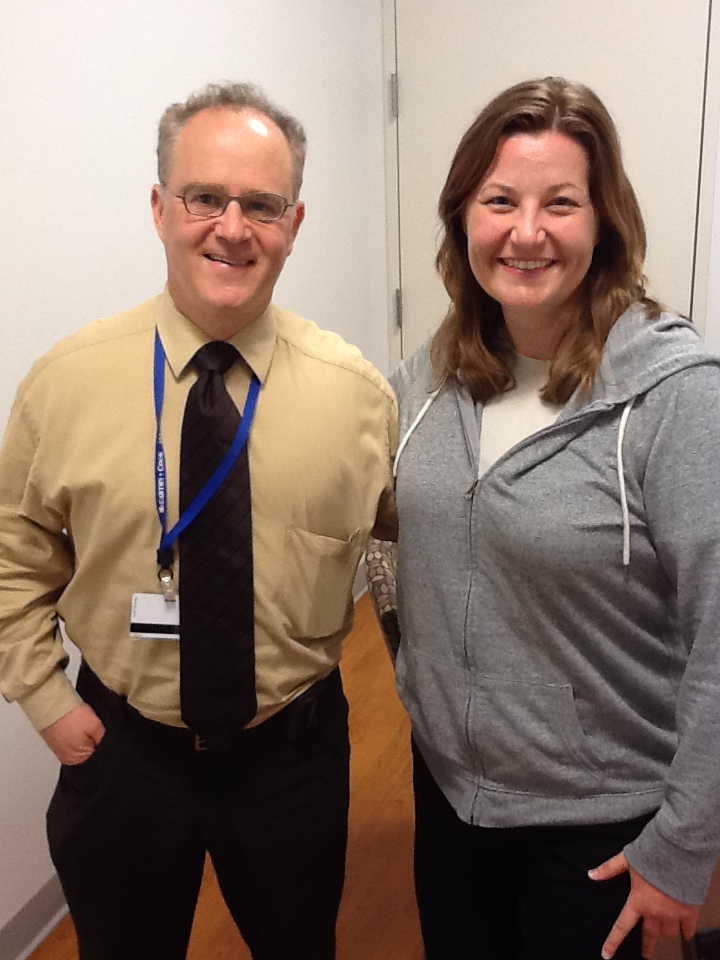
Here I am in May 2012 at the brand new UCSF Neurosciences building in Mission Bay with Dr. Michael Geschwind.
My name is Heather Larson and this blog chronicles my personal experience with CJD since 2004 and seeks to help push for answers and research. My mother, uncle, and their uncle have all died of fCJD, mutation e200K. Our family is from Poland with roots in what is today the Kherson region of Ukraine. My mission is to do everything I can to push the CURE for CJD. Let’s solve this once and for all.
You can email me at TheWriterHeatherLarson [at] protonmail [dot] com.
You can support the work of this site with USD through Cashapp: $coachheather or Buy Me A Coffee.
Support via Bitcoin is appreciated via Alby, lightning ⚡️ address is morningsnowflake162@getalby.com or use Zebedee.

Learn more about some of my past activism here.

Follow on Nostr ⬆️ NPUB: npub1nl8r463jkdtr0qu0k3dht03jt9t59cttk0j8gtxg9wea2russlnq2zf9d0
🔗 Nostr Link [Freedom tech, uncensorable]
More about me:
I finished my undergrad at Boston University (online) and graduated in May 2010. My passions include music of all genres, yoga, writing and finding a cure for CJD. I grew up in both the Bay Area and Scottsdale. A career broadcaster, I worked in radio from 1998-2020 before leaving for TV journalism. I now work as a freelance writer and yoga teacher.
You can learn more about my writing career here.
-
Archives
- March 2024 (1)
- April 2021 (1)
- March 2021 (1)
- February 2021 (1)
- November 2020 (3)
- October 2020 (1)
- May 2018 (1)
- April 2018 (1)
- February 2015 (1)
- December 2014 (1)
- October 2014 (1)
- November 2013 (1)
-
Categories
-
RSS
Entries RSS
Comments RSS
 Cure CJD